


Saint George and the Worlds of Protection
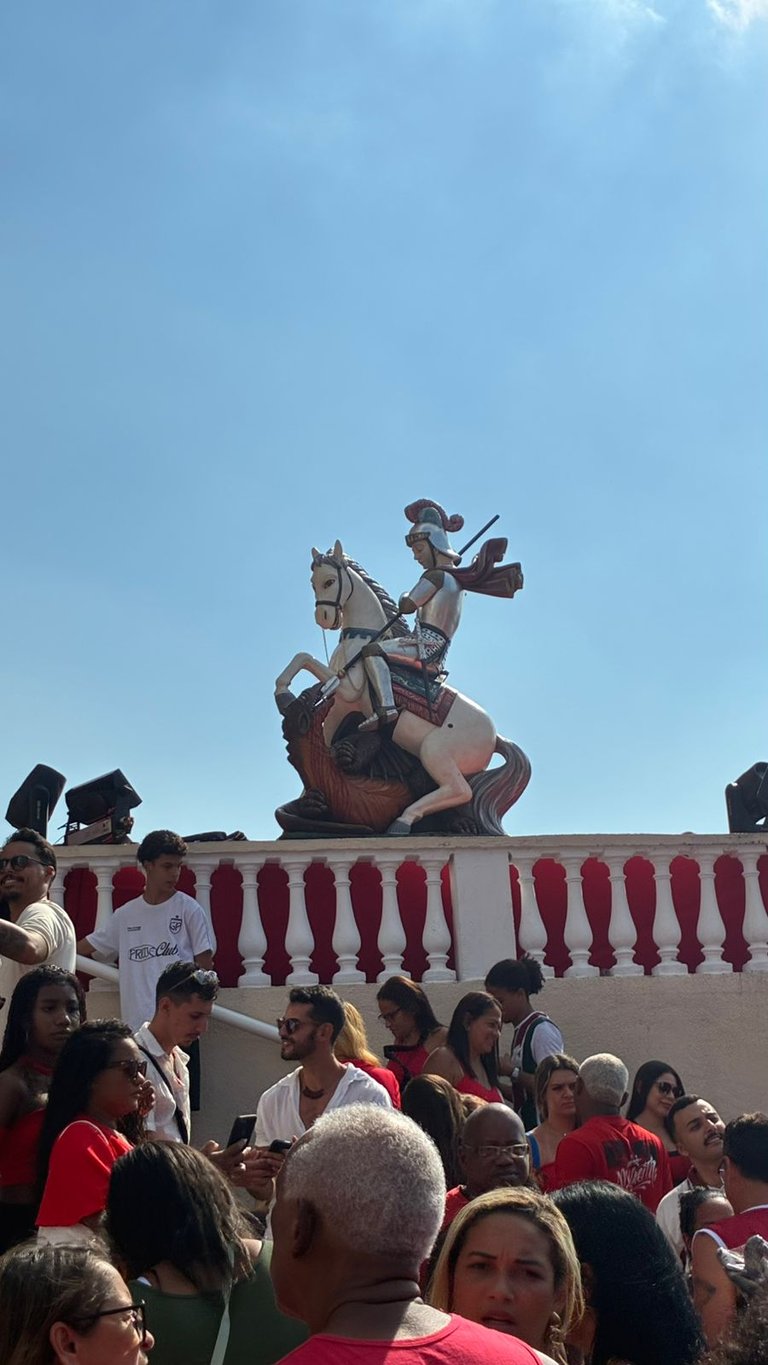
This research follows Saint George through places that are very different from one another. From Mount Athos to Rio de Janeiro, by way of Stockholm, the image of the warrior saint has crossed centuries, borders, and religious traditions without losing one of its most enduring features: its capacity to be called upon in the face of danger.
I am interested in understanding how different communities have appropriated the same image in response to very different historical problems. The dragon is not always the same. Nor are the dangers Saint George is called upon to confront. At different times and in different places, his image has stood alongside monks, soldiers, workers, the poor, migrants, and populations subjected to various forms of violence, dependence, or insecurity.
The research initially unfolds across three field sites.
The first is Mount Athos, where I intend to investigate the presence of Saint George in the Orthodox monastic tradition, particularly in icons, monasteries, chapels, and narratives associated with spiritual protection. In this world, George is above all a martyr and warrior saint. His image belongs to a religious landscape deeply shaped by Byzantine tradition, liturgical life, and the seclusion of monastic communities. I am interested in what the presence of a warrior means in such a world, and against what kinds of threat his protection is invoked.
The second field site is Stockholm, where I have already carried out preliminary research on the monumental presence of Saint George. The celebrated sculpture of Saint George and the Dragon in Storkyrkan was produced in the late fifteenth century, in a context of political and military conflict between Sweden and Denmark. There, the ancient Christian narrative of the saint defeating the dragon became entangled with a local history of war, threat, and political assertion. The image could be recognized as Christian while at the same time speaking to very concrete dangers.
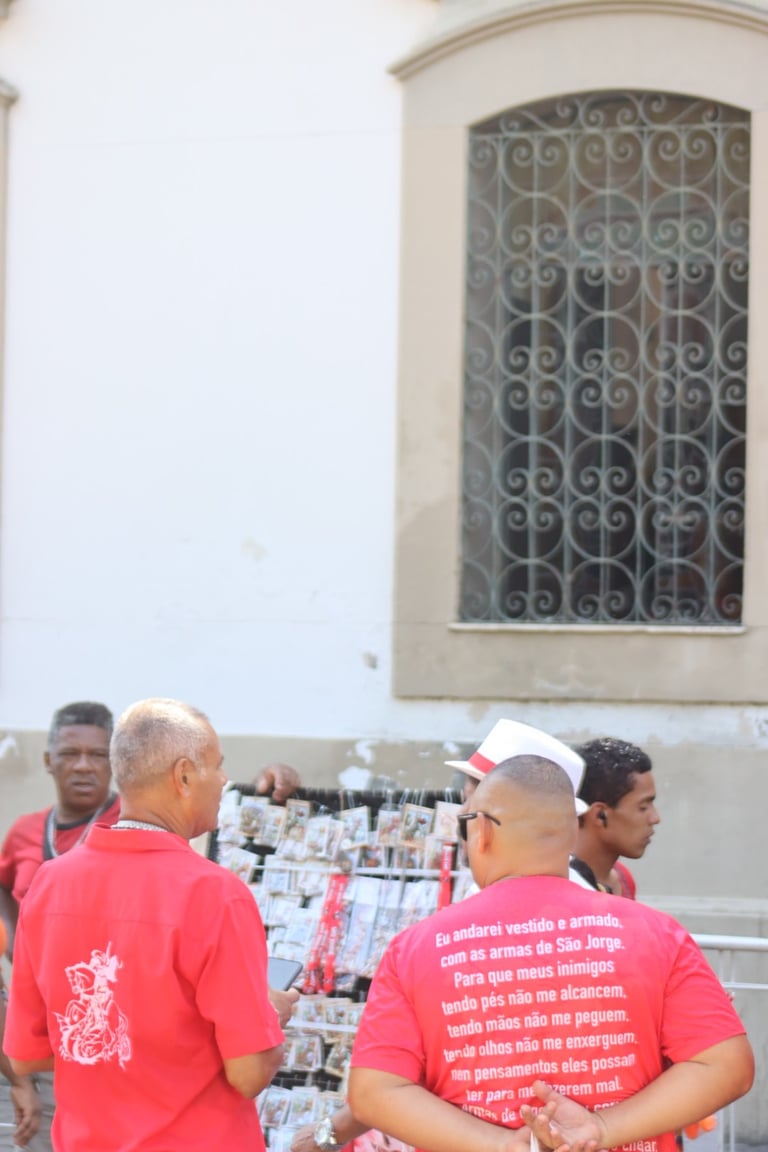
The third field site is Rio de Janeiro. Here, Saint George long ago moved beyond the confines of churches. He is in the streets, in homes, bars, taxis, buses, tattoos, and small domestic altars. On 23 April, his presence transforms parts of the city. Crowds cross Rio to reach the churches in the city centre and in Quintino, while fireworks announce the arrival of the saint’s day in the early hours of the morning.
It is perhaps in Rio that the question guiding this research becomes most evident: what can an image do?
Saint George arrived in a city marked by slavery and remained present among the poor, workers, and inhabitants of its urban peripheries. For those seeking strength and protection against evils that seemed greater than themselves, George was there. Mounted on his white horse, lance in hand, he crossed the city and climbed its hills, reaching the favelas and the suburbs.
But the image does not belong to a single religious world. The proximity between Saint George and Ogum has made the saint part of a much more complex history of the circulation, translation, and reinterpretation of images in Brazil. This is not simply a matter of establishing an equivalence between a Catholic saint and an orixá. What interests me is precisely how different traditions can recognize, in the same warrior figure, powers and meanings that are not necessarily the same.
By bringing Mount Athos, Stockholm, and Rio de Janeiro together, I am not seeking to construct a linear history of the diffusion of Saint George. What interests me is the capacity of an ancient image to enter new worlds and respond to problems that its earliest makers could never have foreseen.
The figure remains remarkably stable: the rider, the horse, the lance, the dragon. The world around it, however, is constantly changing.
Perhaps it is precisely this tension between permanence and transformation that accounts for some of Saint George’s enduring power. Different communities can look at the same image and recognize in it entirely different dangers, enemies, and hopes. The dragon changes. The need for protection remains.
This research is part of the international project Images in Transit: Byzantine Iconography beyond the Borders of the Orthodox World, developed within the framework of cooperation between the State University of Rio de Janeiro and Aristotle University of Thessaloniki. Focusing primarily on images of Saint George and Saint Michael, the project seeks to understand what happens when images produced within particular historical and religious worlds cross borders, enter other societies, and become part of new experiences of devotion, protection, and belonging.
Research Arquives
Insurgency
Research on rebellions, insurgencies and possible ancestral futures
Contact
Resistance
alexbelmonte@gmail.com
© 2026. All rights reserved.
Send us a message.